I know, Halloween is over. I'm sorry these didn't get up sooner, but I'm at a new job this year and that has to come first. However, now you have the info for next Halloween, and several months to get everything ready!
Halloween Stations
These are the stations I start the week before Halloween. They're perfect for this time of year because Halloween is all kids are thinking about. You'll notice that about half of the activities are just Fall/Harvest. If you have students who don't celebrate Halloween, encourage them to just do the Fall activities.
 |
| 10 Ghosts in the Haunted House |
I usually start with the book
10 Timid Ghosts by Jennifer O'Connell. It's fun for the kids to read with me, and there are lots of things you can talk about as you read it. Sometimes we focus on math skills, sometimes on the tricks the witch plays, and sometimes on reading with emotions. Then we have this station, which can also be used as a whole group activity.
-Print a haunted house picture.
-Cut out 10 ghosts and number them.
-Laminate if possible, and put magnets on the back of everything. Attach to a metal or magnetic board.
-Younger students practice putting the ghosts in number order or taking them away in order.
-Older students work in pairs. One puts up three random numbers, the other puts them in order. Then they switch.
 |
| How many ghosts? |
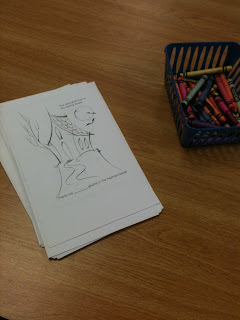
Next, usually near the first station, is the How many ghosts in the haunted house? coloring sheet. This can also be used as a whole group activity. Students draw ghosts in the house, then count them and fill in the blank in the sentence at the bottom: "There are ____ ghosts in the haunted house." I encourage older students to write a number story about the ghosts. For example, "There were 8 ghosts in the haunted house. A giant came and scared away 3 ghosts. Now there are 5 ghosts."
 |
| Connect the Dots |
Here is one of the Fall/Harvest activities. I fill a table with several different connect the dots pages. I have pumpkins, apples, leaves, carrots, and jack-o-lanterns. After students connect the dots and color, they put their names on the back. We cut them out and make a display in the hallway. I have two signs I hang with them. One just says "Our Pumpkin Patch" and the other says: "We made our pumpkins by connecting dots in ABC and number order. These are important skills for finding books in the library!" For the older students, I also put out a trickier number maze.
 |
| Halloween Treats! |
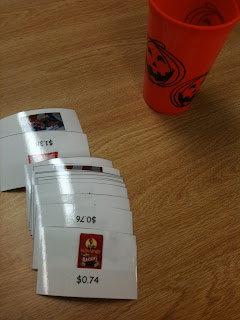
Here students practice putting decimal numbers in order. Older students put the treats in price order from lowest to highest. Younger students like to sort the treats in different ways. All of these help us practice our Dewey Decimal skills.
 |
| Pumpkin Patch |
I adapted this from an idea in a Mailbox magazine. Make 8 pumpkins that are distinctly different. Make a scarecrow and a simple compass on a big green paper. Then place your pumpkins around the scarecrow. Write a set of clues to tell students where to put the pumpkins. "The scary pumpkin is West of the scarecrow. The tiny pumpkin is South of the scary pumpkin." Put these clues on a green paper, and on the back draw a map of what the pumpkin patch should look like. Older students follow your clues, then they check their work with the map. Younger students just try to match the pumpkins to the map locations. Hello map skills!
 |
| I Spy Spooky Night |
The
I Spy books are always popular, especially with the older students. I make a scavenger hunt of things for students to find in the books. When students find the item, they write the page number on the scavenger hunt sheet. To make it easier for the librarian, and more fun for the kids, I put the paper in a plastic page protector. Students write their answers with dry erase crayon or marker, then clean off the paper when they are done. I make two different scavenger hunts - one in pictures for emergent readers, and one in just words. This helps students practice citing the page number of their sources.
 |
| Halloween Floor Puzzle |
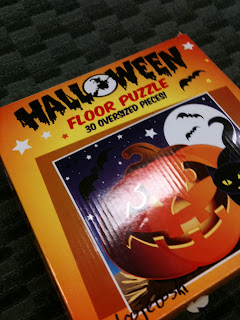
I try to include a puzzle station often. Puzzles have lots of great cognitive benefits for kids, and they're fun! They also encourage collaboration among students. I bought this puzzle at Salvation Army for 25 cents.
Here's a look at how the library is arranged. You can see that we also use floor space for activities.
Another view of the library arrangement.
If you have computer access in the library, there are plenty of great interactive educational games for Halloween and Fall. For younger students I set them up on one game, and when they're done they leave for a different station. For older students, I create a list of links for them to try, and they get five minutes before they switch with someone new.
Even though we're past Halloween, many of these activities can also be adapted for other themes. Make numbered ornaments on a tree instead of ghosts, have snowflake connect the dots, map the sledders on the hill, etc.


